| Model |
CW9800M |
| Maximum number of access points |
3000 |
| Maximum number of clients |
32000 |
| Maximum throughput |
Up to 50 Gbps |
| Maximum WLANs |
4096 |
| Maximum VLANs |
4096 |
| Maximum site tags |
3000 |
| Maximum Flex APs per site |
300 |
| Maximum policy tags |
3000 |
| Maximum RF tags |
3000 |
| Maximum RF profiles |
6000 |
| Maximum policy profiles |
1000 |
| Maximum Flex profiles |
3000 |
| Fixed uplinks |
4x 1/10Gbps + |
| 2x 25Gbps |
| Redundant power supply |
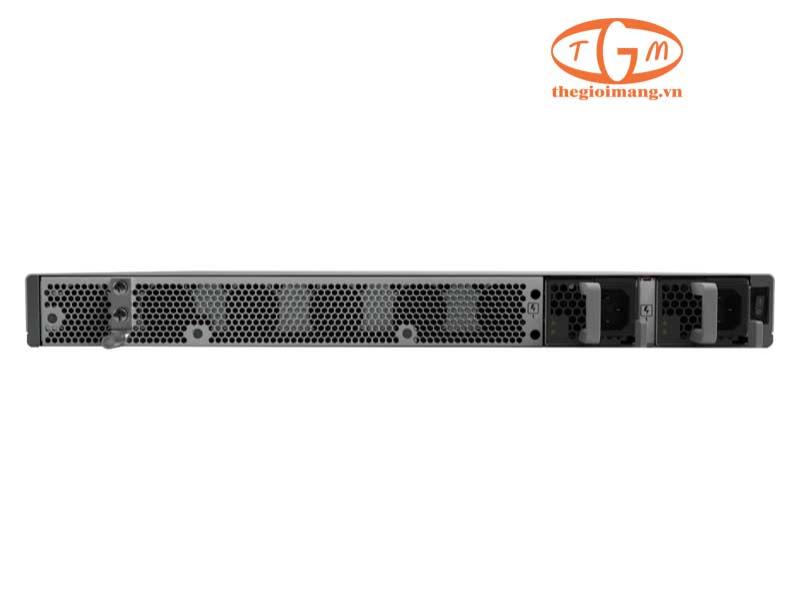
AC power supply |
| Maximum power consumption with modules |
350W |
| Deployment modes |
Centralized, Cisco FlexConnect®, and fabric wireless (SD-Access) |
| Form factor |
1RU |
| License |
Smart License enabled |
| Operating system |
Cisco IOS XE |
| Management |
Integrated WebUI, Cisco Catalyst Center, and third party (open standards APIs)* |
| Policy engine |
Cisco Identity Services Engine (ISE)* |
| Location platform |
Cisco Spaces* |
| Access points |
Aironet 802.11ac Wave 2 access points, Cisco Catalyst 9100 Series 802.11ax access points |
| Standard Power supported with Automated Frequency Coordination where applicable |
| Physical dimensions (WxDxH) |
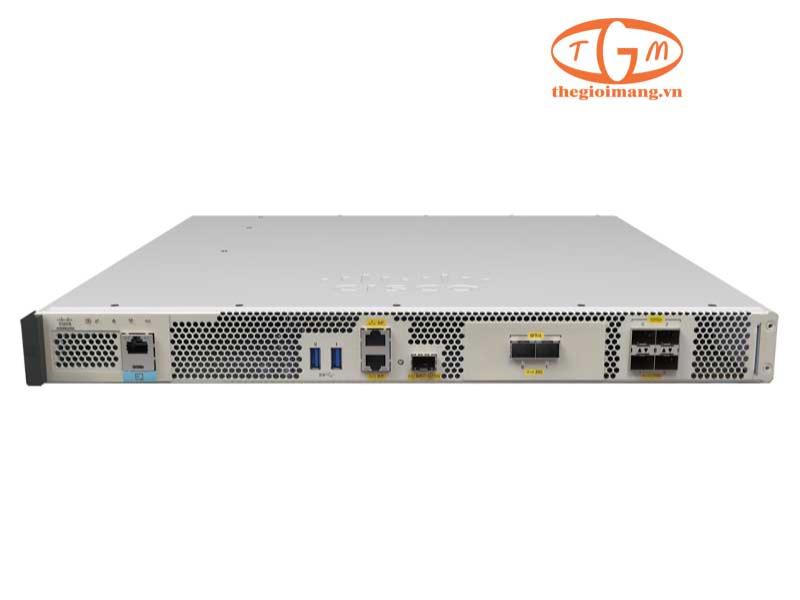
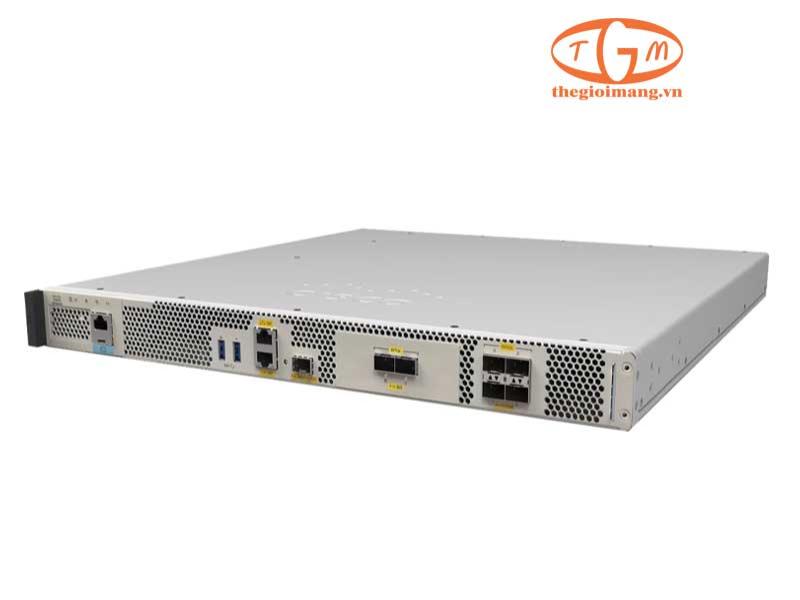
17.3 inches (43.94 cm)x18.4 inches (46.74 cm)x1.73 inches (4.39 cm) |
| Weight |
20.5 lb (9.3 kg) |
| Ports and their purposes |
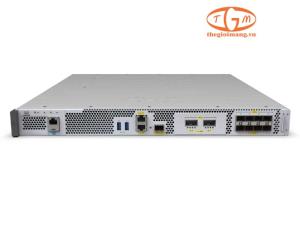
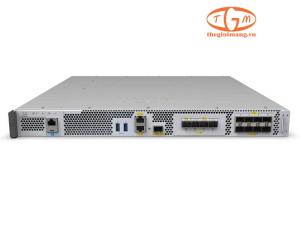
| 1x RJ-45 console port |
Console port for out-of-band management |
| 1x USB 3.0 console port |
Console port for out-of-band management |
| 2x USB 3.0 ports |
USB 3.0 ports for plugging in external memory |
| 1x RJ-45 management port |
Management port for out-of-band management. Also known as the |
| service port |
| 1x RJ-45 redundancy port |
Redundancy port used for SSO |
| 1x SFP 10 Gbps Ethernet redundancy port |
Redundancy port used for SSO; works with Cisco supported SFPs for RP port |
| Fixed uplink ports |
4 x 1/10 Gbps SFP+ |
| 2 x 25 Gbps SFP+ |
| SFPs supported |
| Small Form-Factor Pluggable (SFP) |
GLC-LH-SMD |
| GLC-SX-MMD |
| GLC-TE |
| GLC-ZX-SMD |
| GLC-BX-U |
| GLC-BX-D |
| GLC-EX-SMD |
| Enhanced SFP (SFP+) |
SFP-10G-SR |
| SFP-10G-SR-S |
| SFP-10G-SR-I |
| SFP-10G-LR |
| SFP-10G-LR-X |
| SFP-10G-ER |
| SFP-H10GB-ACU10M |
| SFP-H10GB-CU5M |
| SFP-10G-AOC10M |
| SFP-10G-T-X |
| Finisar-LR (FTLX1471D3BCL) |
| Finisar-SR (FTLX8574D3BC) |
| SFP-H10GB-CU1M |
| SFP-H10GB-CU1-5M |
| SFP-H10GB-CU2M |
| SFP-H10GB-CU2-5M |
| SFP-H10GB-CU3M |
| SFP-H10GB-ACU7M |
| SFP-10G-AOC1M |
| SFP-10G-AOC2M |
| SFP-10G-AOC3M |
| SFP-10G-AOC5M |
| SFP-10G-AOC7M |
| SFP28 (25G) |
SFP-10/25G-CSR-S |
| SFP-10/25G-LR-S |
| SFP-10/25G-LR-I |
| SFP-10/25G-BXD-I |
| SFP-10/25G-BXU-I |
| SFP-25G-ER-I |
| SFP-25G-SR-S |
| SFP-25G-AOC2M |
| SFP-25G-AOC10M |
| SFP-25G-AOC5M |
| Specifications |
| Management interfaces |
● Web-based: HTTP/HTTPS
|
|
● Command-line interface: Telnet, Secure Shell (SSH) Protocol, serial port
|
|
● SNMP
|
|
● NETCONF
|
| Hard Disk Drives (HDD) |
● SATA Solid-State Drive (SSD)
|
|
● 240 GB of memory
|
| Wireless |
IEEE 802.11a, 802.11b, 802.11g, 802.11d, WMM/802.11e, 802.11h, 802.11n, 802.11k, 802.11r, 802.11u, 802.11w, 802.11ac Wave 2, 802.11ax |
| Wired, switching, and routing |
IEEE 802.3 10BASE-T, IEEE 802.3u 100BASE-TX, 1000BASE-T, 1000BASE-SX, 1000-BASE-LH, IEEE 802.1Q VLAN tagging, IEEE 802.1AX Link Aggregation |
| Data standards |
● RFC 768 User Datagram Protocol (UDP)
|
|
● RFC 791 IP
|
|
● RFC 2460 IPv6
|
|
● RFC 792 Internet Control Message Protocol (ICMP)
|
|
● RFC 793 TCP
|
|
● RFC 826 Address Resolution Protocol (ARP)
|
|
● RFC 1122 Requirements for Internet Hosts
|
|
● RFC 1519 Classless Interdomain Routing (CIDR)
|
|
● RFC 1542 Bootstrap Protocol (BOOTP)
|
|
● RFC 2131 Dynamic Host Configuration Protocol (DHCP)
|
|
● RFC 5415 Control and Provisioning of Wireless Access Points (CAPWAP) Protocol
|
|
● RFC 5416 CAPWAP Binding for 802.11
|
| Security standards |
● IEEE 802.11i (WPA2, RSN)
|
|
● Wi-Fi Protected Access 3 (WPA3)
|
|
● RFC 1321 MD5 Message-Digest Algorithm
|
|
● RFC 1851 Encapsulating Security Payload (ESP) Triple DES (3DES) Transform
|
|
● RFC 2104 HMAC: Keyed-Hashing for Message Authentication
|
|
● RFC 2246 TLS Protocol Version 1.0
|
|
● RFC 2401 Security Architecture for the Internet Protocol
|
|
● RFC 2403 HMAC-MD5-96 within ESP and AH
|
|
● RFC 2404 HMAC-SHA-1-96 within ESP and AH
|
|
● RFC 2405 ESP DES-CBC Cipher Algorithm with Explicit IV
|
| RFC 8446 TLS Protocol Version 1.3 |
|
● RFC 2407 Interpretation for Internet Security Association Key Management Protocol (ISAKMP)
|
|
● RFC 2408 ISAKMP
|
|
● RFC 2409 Internet Key Exchange (IKE)
|
|
● RFC 2451 ESP CBC-Mode Cipher Algorithms
|
|
● RFC 3280 Internet X.509 Public Key Infrastructure (PKI) Certificate and Certificate Revocation List (CRL) Profile
|
|
● RFC 4347 Datagram Transport Layer Security (DTLS)
|
|
● RFC 5246 TLS Protocol Version 1.2
|
|
● RFC 8446 TLS Protocol Version 1.3
|
| Encryption standards |
● Advanced Encryption Standard (AES): Cipher Block Chaining (CBC), Counter with CBC-MAC (CCM), Counter with CBC Message Authentication Code Protocol (CCMP)
|
|
● Data Encryption Standard (DES): DES-CBC, 3DES
|
|
● Secure Sockets Layer (SSL) and Transport Layer Security (TLS): RC4 128-bit and RSA 1024-and 2048-bit
|
|
● DTLS: AES-CBC
|
|
● IPsec: DES-CBC, 3DES, AES-CBC
|
| Authentication, Authorization, and Accounting (AAA) |
● IEEE 802.1X
|
|
● RFC 2548 Microsoft Vendor-Specific RADIUS Attributes
|
|
● RFC 2716 Point-to-Point Protocol (PPP) Extensible Authentication Protocol (EAP)-TLS
|
|
● RFC 2865 RADIUS Authentication
|
|
● RFC 2866 RADIUS Accounting
|
|
● RFC 2867 RADIUS Tunnel Accounting
|
|
● RFC 2869 RADIUS Extensions
|
|
● RFC 3576 Dynamic Authorization Extensions to RADIUS
|
|
● RFC 5176 Dynamic Authorization Extensions to RADIUS
|
|
● RFC 3579 RADIUS Support for EAP
|
|
● RFC 3580 IEEE 802.1X RADIUS Guidelines
|
|
● RFC 3748 Extensible Authentication Protocol (EAP)
|
|
● Web-based authentication
|
|
● TACACS support for management users
|
| Management standards |
● Simple Network Management Protocol (SNMP) v1, v2c, v3
|
|
● RFC 854 Telnet
|
|
● RFC 1155 Management Information for TCP/IP-based Internets
|
|
● RFC 1156 MIB
|
|
● RFC 1157 SNMP
|
|
● RFC 1213 SNMP MIB II
|
|
● RFC 1350 Trivial File Transfer Protocol (TFTP)
|
|
● RFC 1643 Ethernet MIB
|
|
● RFC 2030 Simple Network Time Protocol (SNTP)
|
|
● RFC 2616 HTTP
|
|
● RFC 2665 Ethernet-Like Interface Types MIB
|
|
● RFC 2674 Definitions of Managed Objects for Bridges with Traffic Classes, Multicast Filtering, and Virtual Extensions
|
|
● RFC 2819 Remote Monitoring (RMON) MIB
|
|
● RFC 2863 Interfaces Group MIB
|
|
● RFC 3164 Syslog
|
|
● RFC 3414 User-Based Security Model (USM) for SNMPv3
|
|
● RFC 3418 MIB for SNMP
|
|
● RFC 3636 Definitions of Managed Objects for IEEE 802.3 MAUs
|
|
● RFC 4741 Base NETCONF protocol
|
|
● RFC 4742 NETCONF over SSH
|
|
● RFC 6241 NETCONF
|
|
● RFC 6242 NETCONF over SSH
|
|
● RFC 5277 NETCONF event notifications
|
|
● RFC 5717 Partial Lock Remote Procedure Call
|
|
● RFC 6243 With-Defaults capability for NETCONF
|
|
● RFC 6020 YANG
|
|
● Cisco private MIBs
|
| Environmental conditions supported |
Operating temperature: |
|
● Normal: 0° to 40° C (32° to 104°F)
|
|
● Short term:0° to 50° C (32° to 122°F)
|
| Nonoperating temperature: |
|
● -40° to 65° C (-104° to 149°F)
|
| Operating humidity: |
|
● Normal: 10% to 90% noncondensing
|
|
● Short term: 5% to 90% noncondensing
|
| Nonoperating temperature humidity: |
|
● 5% to 93% at 82°F (28°C)
|
| Operating altitude: |
|
● Appliance operating: 0 to 3000 m (0 to 10,000 ft)
|
|
● Appliance nonoperating: 0 to 12,192 m (0 to 40,000 ft)
|
| Electrical input: |
|
● AC input frequency range: 47 to 63 Hz
|
|
● AC input range: 90 to 264 VAC with AC PEM
|
|
● DC input range: -40 to -72 VDC with DC PEM
|
| Maximum power with modules: 350W |
| Heat dissipation: 1194 BTU/hr |
| Sound power level measure: |
|
● Sound power level is 73.5 (dBA) under normal operating conditions
|



 Switch Cisco
 Switch Meraki
 Switch HPE Aruba
 Switch Huawei
 Switch Alcatel
 Switch Extreme
 Switch Juniper
 Switch Fortinet
 Switch Allied Telesis
 Switch Unifi
 Firewall FortiNet
 Firewall Cisco
 Firewall SonicWall
 Firewall CheckPoint
 Firewall Sophos
 Firewall WatchGuard
 Firewall Meraki
 Firewall PaloAlto
 Firewall Huawei
 Router Cisco
 Router Huawei
 Router Juniper
 Router HPE
 Router Mikrotik
 Wifi Cisco
 Wifi Extreme
 Wifi Meraki
 Wifi Huawei
 Wifi Alcatel
 Wifi Fortinet
 Wifi Aruba
 Wifi Unifi
 Module Cisco
 Module Fortinet
 Module Mikrotik
 Server Dell
 Server HPE
 Server Cisco
 NAS Synology
 NAS Qnap
 Microsoft Software
 Kaspersky License
 Zoom License
 Video Conference
 Điện thoại IP
 Bộ lưu điện UPS
 Tủ Rack
 Cáp quang
 Cáp mạng
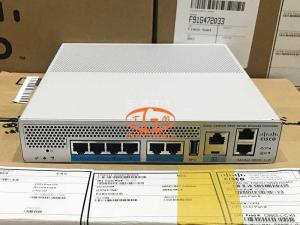

CW9800M hỗ trợ những chuẩn Wi-Fi và dòng Access Point nào của Cisco?
CW9800M hỗ trợ các chuẩn IEEE 802.11ac Wave 2 và IEEE 802.11ax (Wi-Fi 6), tương thích với Cisco Aironet 802.11ac Wave 2 Access Points và Cisco Catalyst 9100 Series Access Points, giúp doanh nghiệp dễ dàng mở rộng hoặc nâng cấp hạ tầng mạng không dây.
CW9800M hỗ trợ những chế độ triển khai mạng không dây nào?
CW9800M hỗ trợ ba chế độ triển khai gồm Centralized, Cisco FlexConnect và Fabric Wireless (SD-Access). Điều này giúp doanh nghiệp linh hoạt triển khai từ hệ thống mạng tập trung, các chi nhánh từ xa đến kiến trúc mạng tự động hóa dựa trên Cisco SD-Access.
CW9800M hỗ trợ tối đa bao nhiêu Access Point và Wireless Client trong một hệ thống?
CW9800M hỗ trợ quản lý tối đa 3.000 Access Point và 32.000 Wireless Client, đồng thời hỗ trợ 4.096 WLAN và 4.096 VLAN. Với thông lượng lên đến 50 Gbps, thiết bị đáp ứng tốt các hệ thống mạng doanh nghiệp và khuôn viên (campus) quy mô lớn.